A claw machine business can look simple from the outside: place a machine in a busy location, fill it with prizes, and collect payments. In practice, profitability depends on several connected factors, including equipment cost, venue terms, prize expenses, payment fees, maintenance, customer demand, and machine performance.
The most useful way to evaluate the opportunity is not to ask, “How much money does a claw machine make?” Instead, ask:
This guide explains how to build a realistic claw machine business cost and profitability model. It is designed for arcade operators, retailers, family entertainment venues, restaurants, and first-time entrepreneurs who want to make decisions using their own local figures.
Important: No article can guarantee a specific return. Revenue varies by location, local pricing, machine quality, prize selection, seasonality, and operating agreement. Use your actual supplier quotes, venue terms, local taxes, and payment fees before investing.
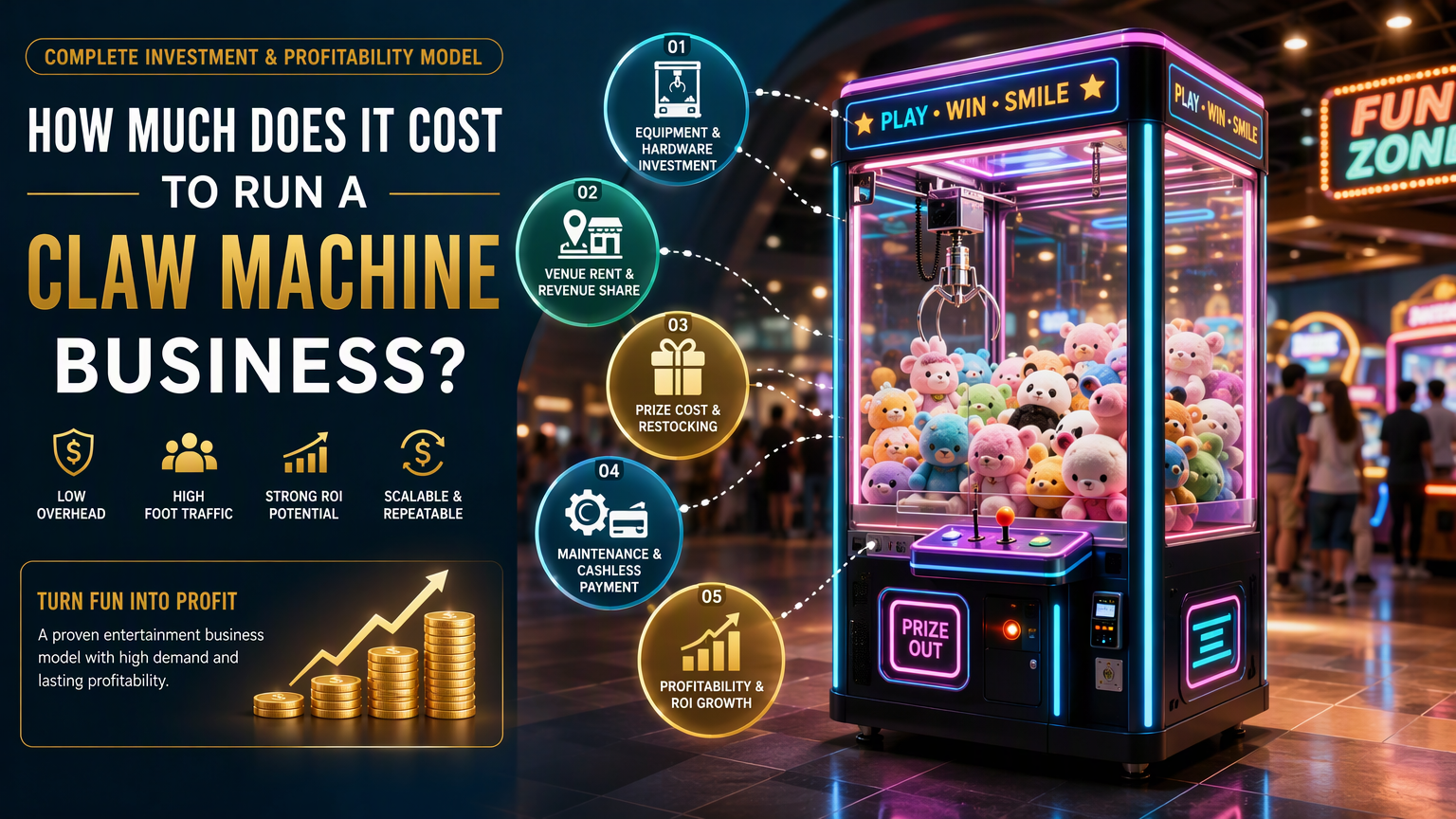
The initial investment normally includes more than the machine itself. A complete budget should include the following categories.
The machine is usually the largest equipment expense. The final price may depend on its size, cabinet design, number of players, control system, payment options, lighting, warranty, and customization.
When comparing machines, look beyond the purchase price. A lower-priced machine may become more expensive if it has higher downtime, difficult-to-source parts, limited payment support, or weak after-sales service.
Ask suppliers for:
If cash flow is limited, leasing or revenue-share placement may reduce the upfront payment. However, compare the total amount paid over the contract term and check who is responsible for repairs, transport, insurance, and removal.
Budget for transportation from the supplier to the final venue. Costs can include domestic delivery, international freight, customs or import charges, unloading, assembly, and installation.
Large cabinets may require special handling. Confirm whether the venue has suitable access through doors, elevators, loading areas, and corridors before ordering.
A machine cannot generate revenue without prizes. Your opening inventory may include plush toys, licensed products, novelty items, small electronics, or other prizes suitable for the audience and machine specifications.
Prize cost should be measured by the actual replacement cost, not only by the retail value shown to customers. Also consider:
The best prize is not necessarily the most expensive one. It should be visually attractive, appropriate for the machine, and relevant to the people who visit the venue.
Some venues need electrical work, floor protection, signage, lighting, network access, or a dedicated payment connection. Include these costs in the launch budget rather than treating them as unexpected expenses.
Before installation, verify the machine's footprint, clearance requirements, power outlet location, customer walking space, and visibility from the main traffic area.
Depending on your location and business structure, you may need to budget for business registration, permits, insurance, tax registration, inspection, and signage approval. Rules can differ by jurisdiction and by venue type.
Do not assume that a machine is automatically classified as ordinary entertainment equipment. Confirm local requirements with the relevant authority or a qualified professional.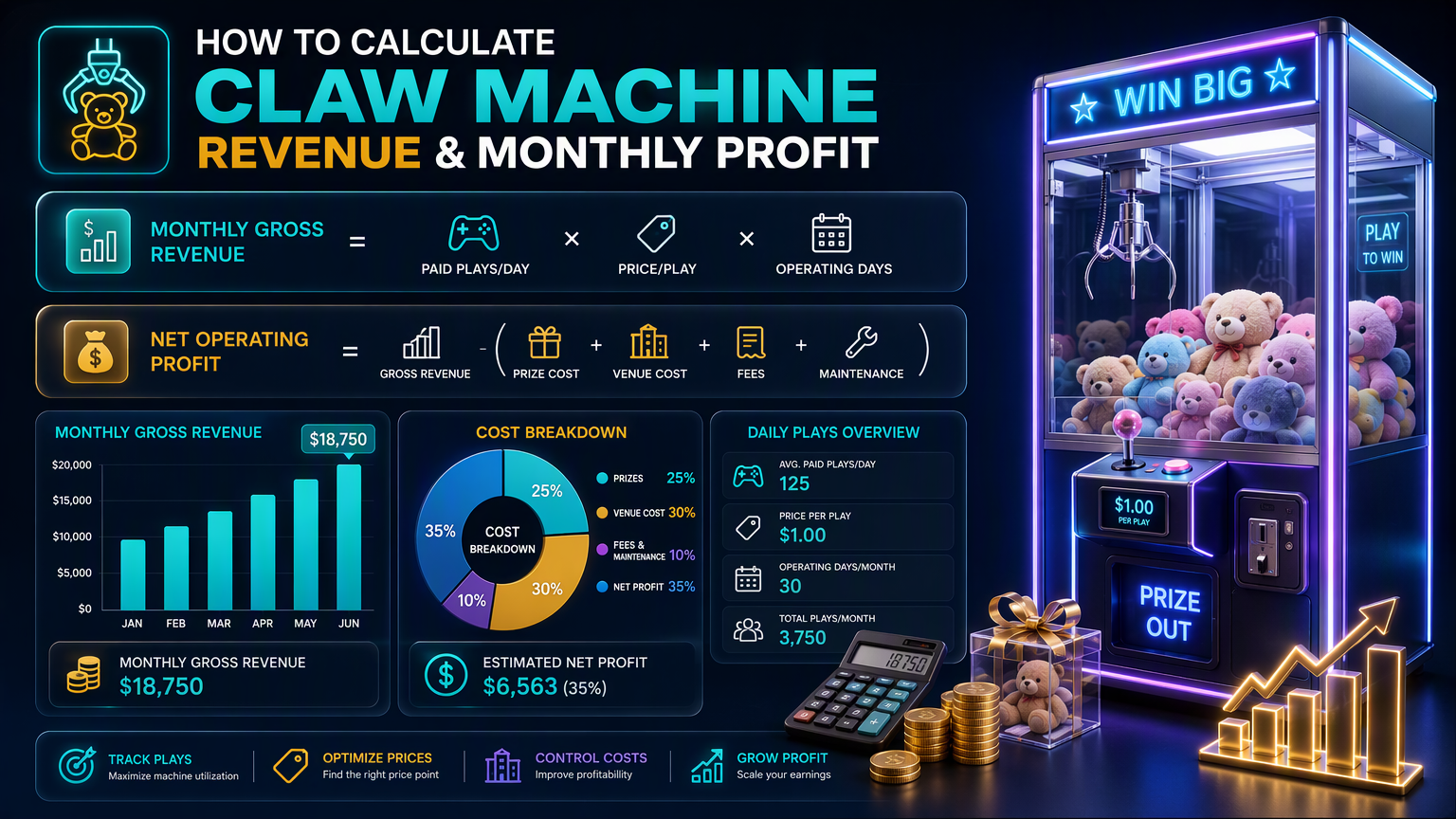
Monthly costs determine whether a machine remains profitable after the initial purchase. Track each category separately so that you can identify problems quickly.
The venue agreement may use a fixed monthly fee, a percentage of revenue, or a hybrid structure. Each model changes your break-even point.
A fixed fee creates a predictable cost but increases your risk if traffic is weak. A revenue-share agreement may reduce downside risk but can become more expensive as revenue grows. The contract should clearly define revenue, payment processing deductions, service responsibilities, access hours, and termination terms.
Prize expense is often variable: it rises when the machine receives more plays. Calculate the prize cost per paid play using your actual payout records.
A useful measure is:
Prize cost per play = Total prize replacement cost ÷ Total paid plays
Avoid judging performance only by how full the machine looks. A machine may attract attention but still perform poorly if its prize cost, payout settings, or venue fee is too high.
Cashless systems can improve convenience and reduce coin-handling work, but they may involve transaction fees, platform charges, hardware costs, or connectivity fees. Record these charges as a separate operating expense.
Make sure the payment system supports the currencies, payment methods, receipts, and reporting features required by your market.
Electricity consumption may be modest compared with rent or prize cost, but it should still be included in the model. Connectivity may also be required for cashless payments, remote monitoring, or software updates.
Use the machine's rated power information and local utility rates to estimate energy cost. For a more accurate figure, measure actual consumption after installation.
Common maintenance tasks include cleaning the cabinet, checking the claw mechanism, testing controls, removing jammed prizes, inspecting wiring, and updating product displays.
Repairs may involve motors, sensors, joysticks, bill acceptors, coin mechanisms, screens, lighting, or control boards. Keep a spare-parts plan and record downtime. A machine that is unavailable during busy periods is losing potential revenue even when no repair invoice has been issued.
A multi-location operation may need staff to refill prizes, collect cash, clean machines, resolve customer issues, and perform inspections. Include driving time, fuel, delivery supplies, and inventory handling in the operating budget.
Remote reporting can reduce unnecessary visits, but it does not eliminate the need for physical inspection and customer support.
Promotions can attract first-time players and encourage repeat visits. Possible activities include seasonal prize themes, loyalty programs, venue signage, social media content, and cross-promotions with the host business.
Measure the result of each promotion. A discount that increases plays may still reduce profit if it lowers average revenue more than it improves traffic.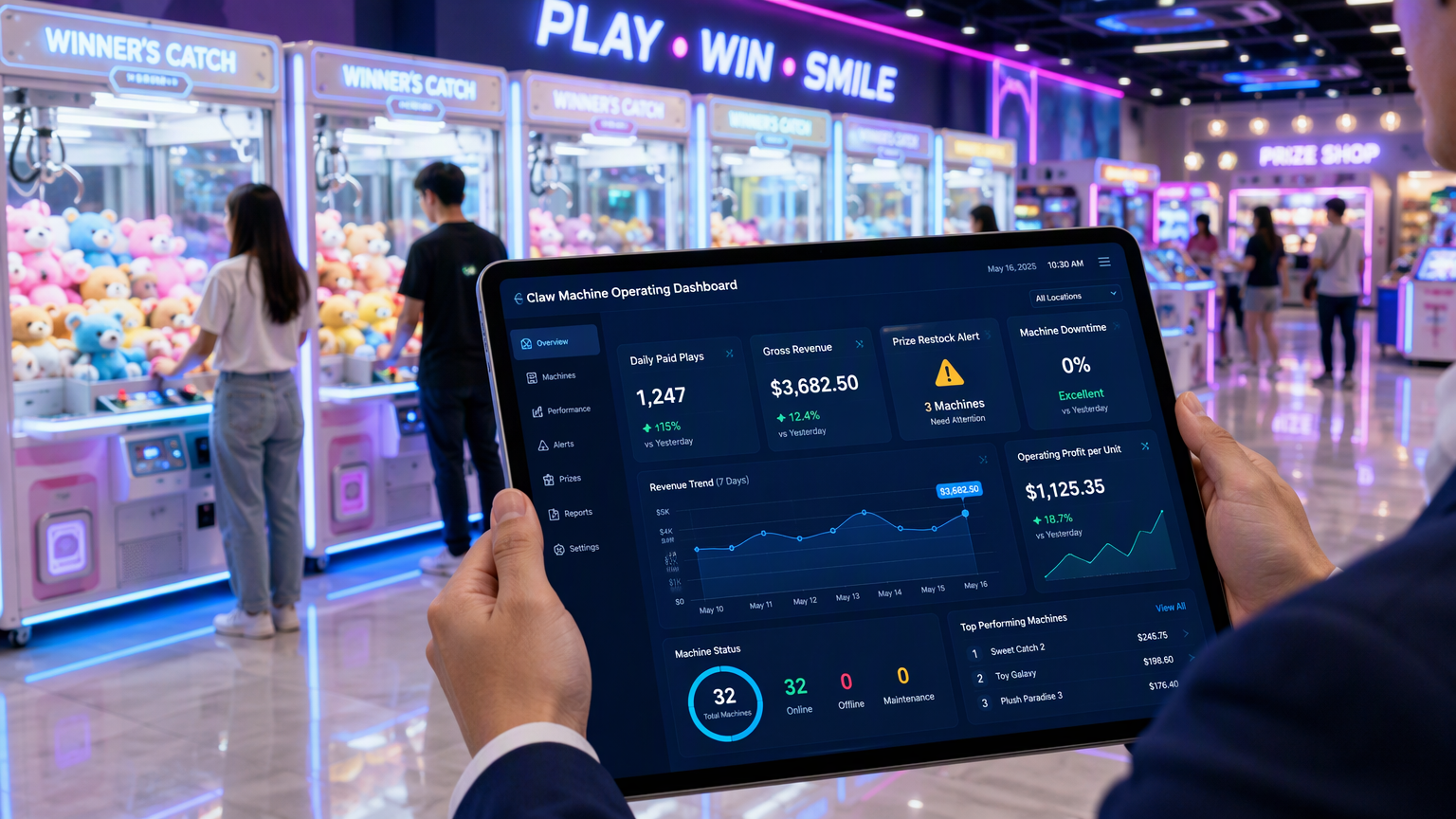
Revenue forecasting should begin with observed or testable inputs rather than an optimistic sales target.
Use this basic formula:
Monthly gross revenue = Paid plays per day × Price per play × Operating days per month
For a multi-machine business:
Total monthly gross revenue = Sum of each machine's monthly gross revenue
The three most important inputs are:
Start with a conservative forecast, then create a base case and an upside case. Do not use one optimistic estimate as the business plan.
Gross revenue is not the same as profit. Subtract all operating costs before evaluating performance.
Monthly operating profit = Gross revenue − Prize cost − Venue cost − Payment fees − Electricity − Maintenance − Labor − Other operating costs
If you are evaluating the full business, also account for insurance, taxes, depreciation, financing costs, and central overhead. These items may not be assigned to one machine but still affect the owner's actual return.
A useful operating dashboard should show, for each machine:
Review the dashboard weekly during the launch period and monthly after performance becomes more stable.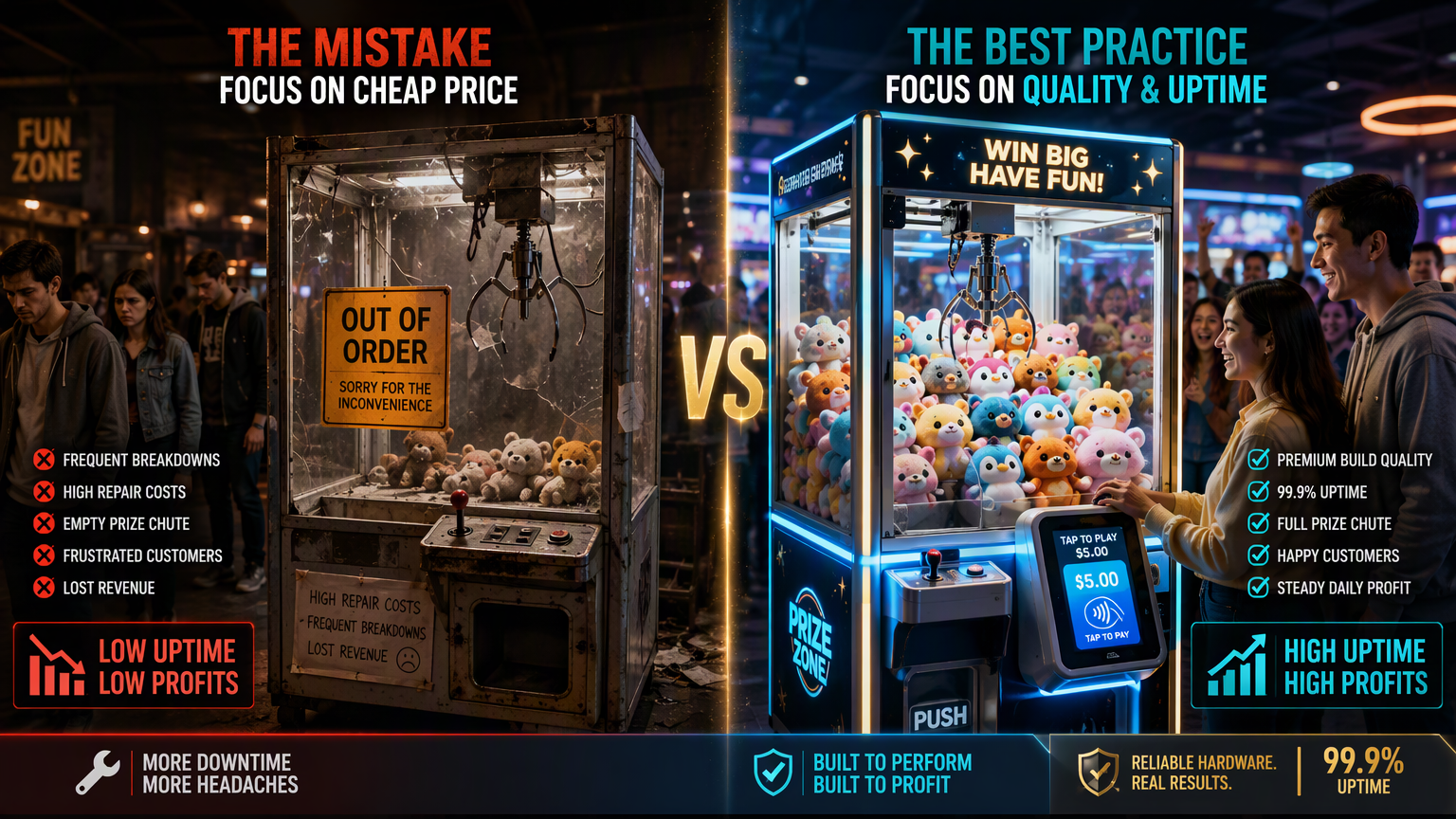
The break-even point shows how many plays are needed to cover costs.
First, calculate the contribution from one play:
Contribution per play = Price per play − Average prize cost per play − Variable payment fee per play
Then calculate required plays:
Break-even plays per month = Monthly fixed costs ÷ Contribution per play
Fixed costs may include venue rent, software subscriptions, insurance, and a monthly maintenance allowance. Variable costs usually rise with the number of plays, such as prize replacement and transaction fees.
To calculate the daily target:
Break-even plays per day = Break-even plays per month ÷ Operating days per month
This figure gives you a practical test. If a location cannot reasonably generate the required number of plays, renegotiate the venue terms, adjust the machine or prize mix, or choose a different location.
The payback period estimates how long it takes for operating profit to recover the initial investment.
Payback period = Total initial investment ÷ Average monthly operating profit
Include all launch costs in the numerator, including equipment, freight, installation, initial prizes, setup, and compliance expenses. Use actual operating profit—not gross revenue—in the denominator.
Payback is only one decision metric. A machine with a faster payback may still require more maintenance or have a shorter useful life. Consider reliability, resale value, customer experience, and the time required to operate the machine.
Location is often more important than the machine's appearance. A strong location typically combines relevant customer traffic, visibility, dwell time, and a convenient payment experience.
Evaluate potential venues using the following questions:
Do not judge a site by foot traffic alone. A location with high traffic but poor visibility or an unsuitable audience may generate fewer plays than a smaller venue with better customer fit.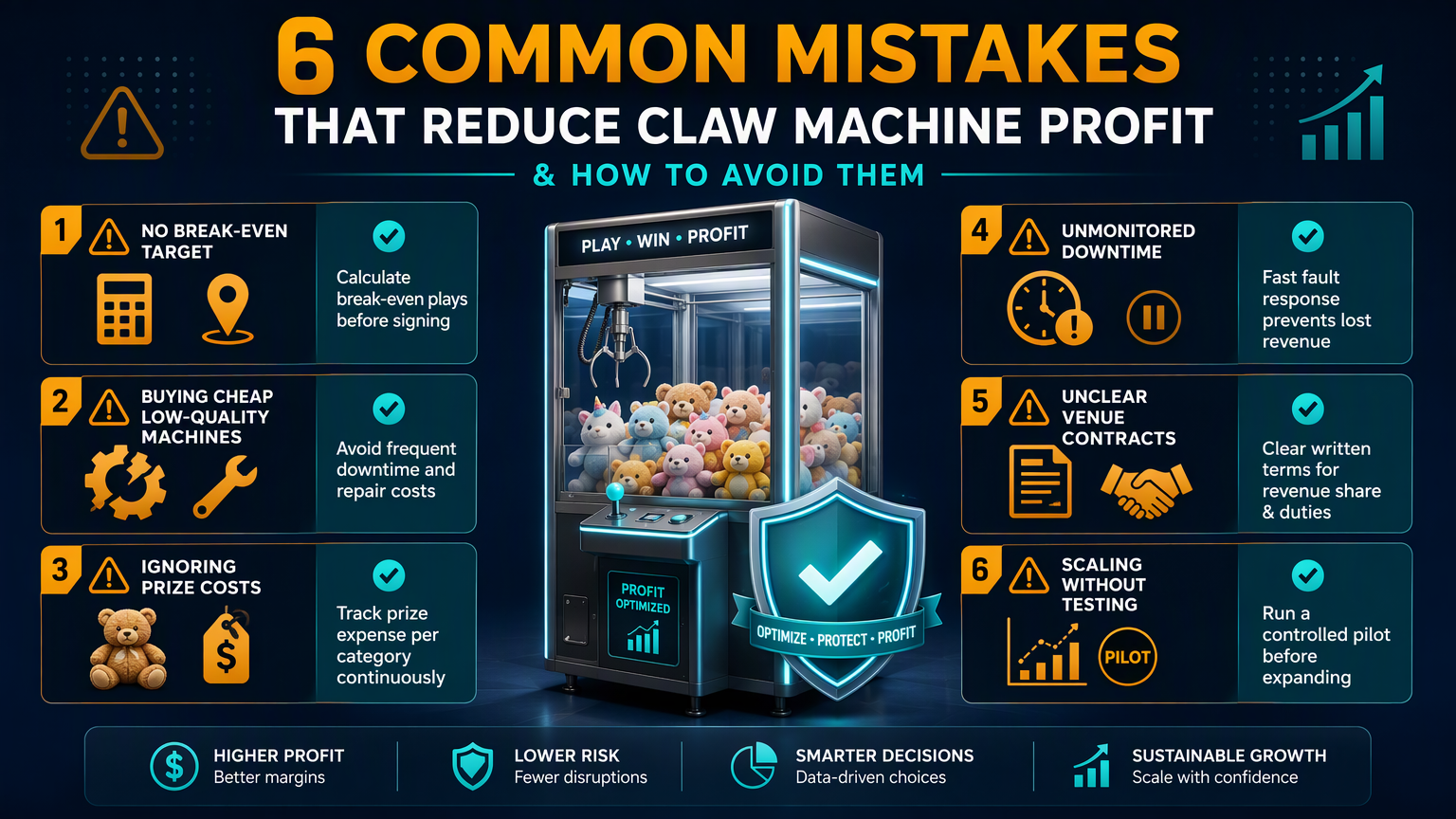
Prize selection influences both demand and operating cost. Test a small assortment before committing to a large inventory purchase.
Track which prizes:
Keep the display fresh, but avoid changing products so often that you cannot compare performance. Use sales and payout records to guide decisions instead of relying only on personal preference.
A popular venue is not automatically profitable. Calculate the required plays before signing a contract.
A cheap machine can create higher long-term costs through repairs, downtime, poor payment compatibility, or limited support.
Prize expense directly affects contribution per play. Measure it continuously and keep records by product category.
A machine that is not working cannot earn revenue or provide a good customer experience. Track faults and response time.
Put the payment model, access rights, maintenance duties, revenue definition, and contract term in writing.
Start with a controlled pilot when possible. Use real operating data to decide which locations, prizes, prices, and machine types deserve expansion.
Before launching, confirm that you have:
The cost of running a claw machine business is not limited to the machine purchase. The real operating model includes prizes, venue fees, payment processing, maintenance, labor, electricity, marketing, compliance, and downtime.
The most reliable approach is to build a machine-level profit model, test the location, measure actual plays and prize costs, and make decisions from operating data. A well-maintained machine in a suitable venue can create an attractive entertainment business, but profitability depends on disciplined cost control and continuous optimization.
If you are comparing equipment, request a detailed quote that includes machine specifications, warranty terms, spare parts, payment compatibility, shipping, and after-sales support. These details make it easier to compare the true cost of ownership—not just the advertised machine price.

Copyright © Guangzhou Fun Forward Technology Co., Ltd - Privacy policy
 EN
EN